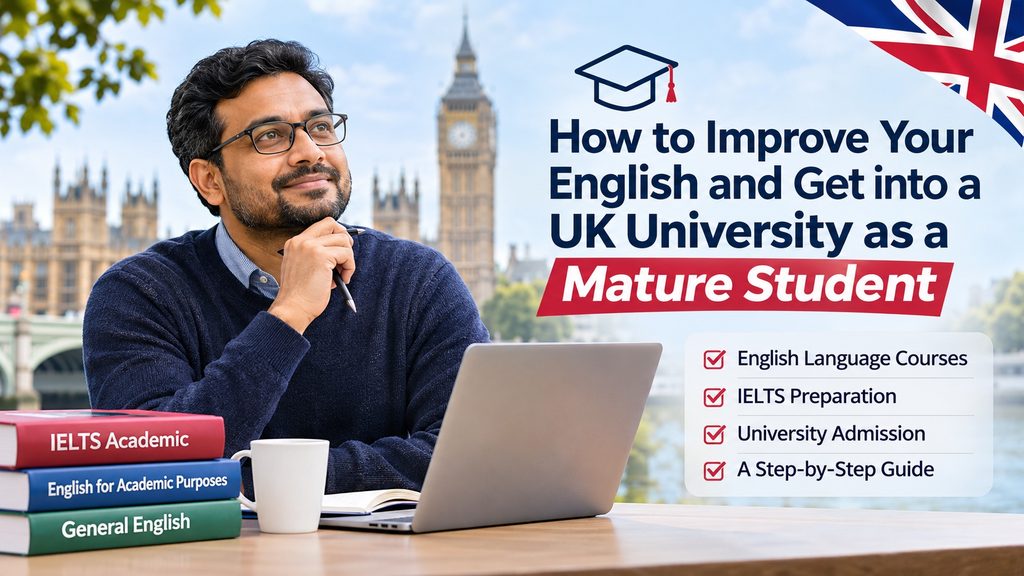
How to Improve Your English and Get into a UK University as a Mature Student
Are you a mature student in Bangladesh hoping to study at a university in the United Kingdom? Perhaps you left education several years ago, have been working for a long time, or want to gain a degree to improve your career prospects.
The good news is that returning to education as an adult is possible. UK universities welcome students from different backgrounds, including those who have taken a break from formal education. However, preparing for university admission requires careful planning, particularly when it comes to your English language skills.
For many international students, improving English and preparing for IELTS Academic are important steps towards meeting university admission requirements.
In this guide, we explain how mature students can improve their English, prepare for IELTS and work towards gaining admission to a UK university.
Who Is a Mature Student in the UK?
A mature student is generally someone who enters higher education later than the traditional school-leaving age.
In the UK, universities often consider applicants aged 21 or above as mature students for undergraduate admission, although the definition can vary between institutions and courses.
Mature students may include:
- Adults who completed their education several years ago.
- Professionals who want to change careers.
- Parents returning to education after raising children.
- Individuals who want to improve their qualifications.
- Students who have relevant work experience but limited formal academic qualifications.
You do not necessarily need to follow the traditional route of completing school, college and university at a young age.
Some universities may consider relevant work experience, professional qualifications or alternative academic pathways. However, admission requirements vary by university and programme.
The UK government's mature student guidance explains that some institutions accept professional qualifications and relevant work experience, while others may require A levels, Access to Higher Education qualifications or equivalent credentials.
Why English Language Skills Matter for University Admission
Studying at a UK university requires more than understanding everyday English.
You will need to communicate effectively with lecturers, participate in discussions, understand academic materials and complete written assignments.
Strong English language skills can help you:
- Understand lectures and academic presentations.
- Read textbooks and research materials.
- Write essays, reports and assignments.
- Participate confidently in seminars.
- Communicate with classmates and university staff.
For students who have been away from education for many years, academic English may feel challenging at first.
This is why preparing in advance can make a significant difference.
Rather than focusing only on passing an English language test, mature students should develop the practical language skills needed for university study.
What English Courses Can Mature Students Take?
There are several types of English courses that can help adults prepare for higher education in the UK.
1. IELTS Academic Preparation Courses
IELTS Academic is widely used by universities to assess the English language ability of international applicants.
An IELTS preparation course can help students improve their performance in:
- IELTS Listening
- IELTS Reading
- IELTS Writing
- IELTS Speaking
A structured IELTS course can also help you understand the test format, practise different question types and develop effective examination techniques.
For students planning to apply to a UK university, IELTS Academic preparation can be particularly useful when the chosen institution requires an IELTS score.
However, IELTS is not the only possible way to demonstrate English proficiency. Some universities accept other recognised English language qualifications.
2. General English Courses
If your English is at a beginner or intermediate level, you may benefit from a General English course before starting IELTS preparation.
These courses typically focus on:
- Everyday vocabulary.
- Grammar and sentence structure.
- Listening comprehension.
- Speaking and pronunciation.
- Reading and writing.
General English courses can help mature students build confidence and establish a stronger foundation before progressing to academic English or IELTS preparation.
3. English for Academic Purposes (EAP)
English for Academic Purposes courses are designed to prepare students for studying in an academic environment.
They may cover academic writing, research skills, critical reading, note-taking and seminar participation.
These courses can be particularly helpful for students who have already achieved a reasonable level of English but need to develop the skills required for university assignments.
4. Pre-sessional English Courses
Some UK universities offer pre-sessional English courses for international students who have received an offer but do not yet meet the required English language standard.
These courses are designed to help students improve their English before beginning their main academic programme.
Depending on the university and course, successful completion may allow students to progress to their degree without taking another English language test.
Always check the specific university's requirements, as pre-sessional course eligibility and progression conditions differ.
What IELTS Score Do Mature Students Need for UK University Admission?
There is no single IELTS score required by every UK university.
The required score depends on the university, course, qualification level and subject.
For example, some undergraduate courses may require an overall IELTS Academic score of 6.0, while others may require 6.5 or higher.
Some universities also set minimum scores for individual components.
| IELTS component | Skills assessed |
|---|---|
| Listening | Understanding spoken English |
| Reading | Understanding written texts |
| Writing | Academic writing and written communication |
| Speaking | Spoken communication and fluency |
A university may require an overall score of 6.5 with no individual component below 6.0, for example. This is an illustration only, not a universal admission requirement.
Before booking your IELTS test, check the English language requirements for your intended course.
You can also contact the university's admissions team if you are unsure whether your existing qualifications or English language certificate will be accepted.
Can Mature Students Apply to UK Universities Without IELTS?
Yes, in some circumstances.
Some UK universities accept alternative English language qualifications or may assess an applicant's English proficiency through another approved method.
Possible alternatives include:
- Other recognised English language tests.
- Previous academic qualifications taught in English.
- University-approved English language assessments.
- Pre-sessional English courses.
However, acceptance depends on the university and the programme.
It is also important to distinguish between university admission requirements and UK Student visa requirements.
For a Student visa, applicants studying at degree level or above generally need to demonstrate English proficiency at CEFR B2 level. A licensed higher education provider may be able to assess the applicant's English itself, subject to the applicable rules. https://www.gov.uk/student-visa/knowledge-of-english
Therefore, do not assume that completing a general English course automatically satisfies the English language requirement for university admission or a Student visa.
How to Improve Your English Before Applying to a UK University
Improving your English does not happen overnight. However, with a structured learning plan, mature students can make steady progress.
Step 1: Assess Your Current English Level
Begin by identifying your current English language ability.
Are you comfortable speaking English but struggle with writing? Can you understand conversations but find academic reading difficult?
A level assessment can help you identify the areas that need improvement.
For example:
- Beginner learners may benefit from foundational English courses.
- Intermediate learners may focus on grammar, vocabulary and communication.
- Upper-intermediate learners may begin IELTS Academic preparation.
Understanding your starting point helps you choose the right course.
Step 2: Practise English Every Day
Consistent practice is more effective than studying intensively only once or twice a week.
Try to include English in your daily routine.
You could:
- Read English newspapers and online articles.
- Listen to English podcasts or educational videos.
- Practise speaking with friends or classmates.
- Write a short paragraph about your daily activities.
- Learn five to ten new words each day.
Even 30 to 60 minutes of regular practice can help you build confidence over time.
Step 3: Improve Your Academic Vocabulary
University study often involves specialised vocabulary that may not appear in everyday conversations.
Start learning words and phrases used in academic contexts.
For example:
- Analyse
- Evaluate
- Compare
- Discuss
- Demonstrate
- Evidence
- Research
- Conclusion
Understanding these words can help you interpret assignment questions and express your ideas more clearly.
Step 4: Develop Your IELTS Skills
Once you have a suitable foundation in English, begin preparing for IELTS Academic if your chosen university requires it.
Focus on understanding the test format and practising each component.
For IELTS Reading, practise identifying main ideas, locating specific information and understanding unfamiliar vocabulary.
For IELTS Writing, develop your ability to organise ideas into clear paragraphs and write accurate sentences.
For IELTS Listening, practise understanding different accents and identifying key information.
For IELTS Speaking, work on fluency, pronunciation and answering questions with relevant examples.
Regular mock tests can help you identify weaknesses and measure your progress.
Step 5: Take a Structured English Course
Self-study is useful, but a structured course can provide guidance, feedback and accountability.
An experienced English language teacher can help you identify recurring mistakes, improve your grammar and develop your communication skills.
For mature students balancing employment, family responsibilities and education, a planned learning schedule can make preparation more manageable.
Government Funded Matutre
Mature Student Admission in the UK: Find the Right University Pathway
Improving your English and preparing for IELTS Academic are important steps towards studying at a UK university. However, mature students also need to consider university entry requirements, course options, application procedures and potential student finance opportunities.
If you are returning to education after a long break, understanding the admission process can help you make informed decisions about your future. Whether you want to pursue an undergraduate degree, change careers or improve your professional qualifications, there may be different university pathways available depending on your academic background and experience.
Learner Care provides guidance for mature students exploring university admission opportunities across the UK. You can explore our mature student admission guidance to understand the different routes available to adults returning to education.
If you are considering studying in a particular city, explore our location-specific guidance:
- Mature student admission in London: Explore university admission opportunities and guidance for mature students in London.
- Mature student admission in Birmingham: Learn about university admission pathways for adults considering higher education in Birmingham.
- Mature student admission in Manchester: Discover guidance for mature students planning to return to education in Manchester.
Choosing the right university and preparing your application carefully can make your journey towards higher education more manageable. Alongside improving your English language skills, take time to research your preferred course, check academic entry requirements and understand the application process.
With the right preparation and guidance, you can take confident steps towards achieving your educational goals in the UK.