IELTS Preparation Guide
IELTS Speaking Tips and Tricks to Improve Your Score
Preparing for the IELTS Speaking test can feel challenging, particularly if English is not your first language. With the right IELTS Speaking tips and tricks, regular practice and a clear strategy, you can become a more confident and effective speaker.
You do not need a perfect accent or complicated vocabulary. Focus on expressing your ideas clearly, developing your answers and speaking naturally. This guide covers all three parts of the test, along with practical techniques for fluency, pronunciation and vocabulary.
Introduction
Answer familiar questions about your life, work, studies and interests.
Long Turn
Prepare notes for one minute and speak about your cue-card topic for up to two minutes.
Discussion
Explain opinions, compare ideas and discuss broader issues with relevant examples.
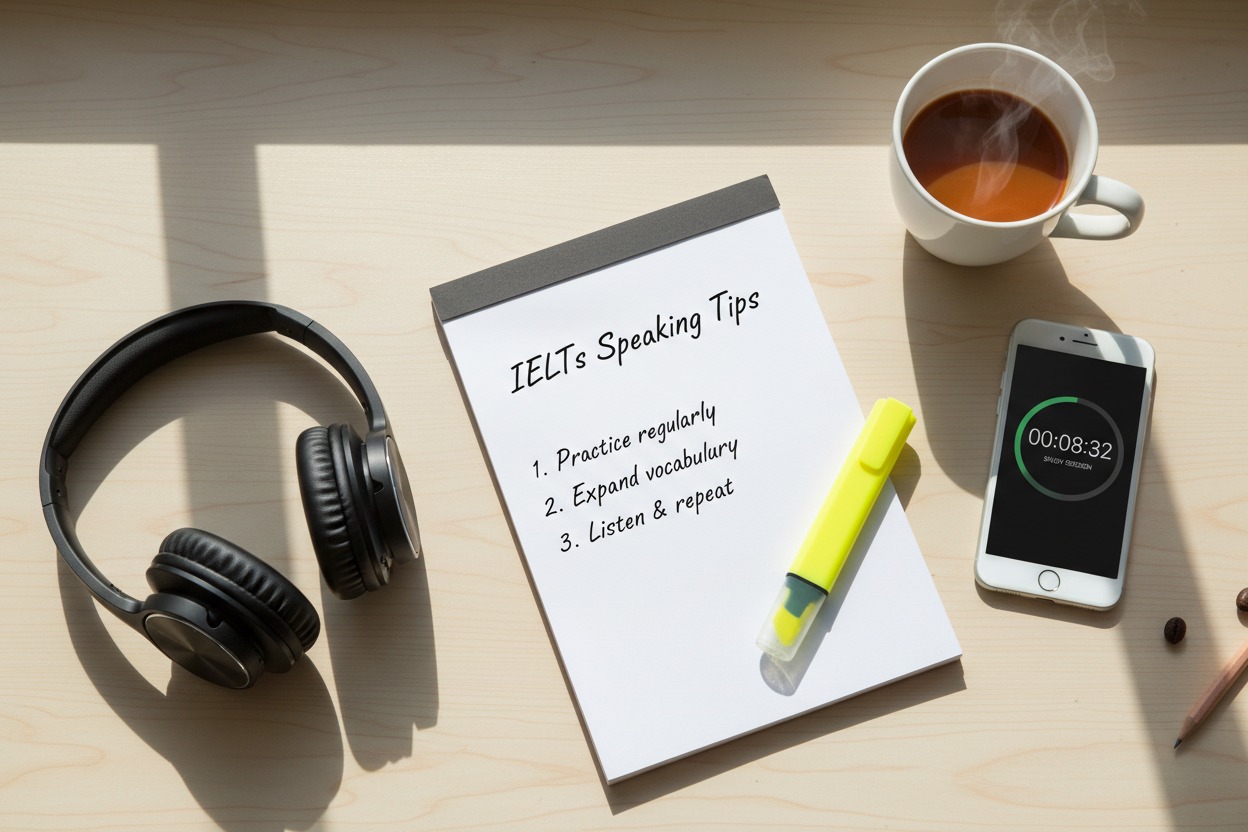
Build Better Speaking Habits
Effective IELTS Speaking preparation is about communicating clearly, not memorising perfect answers. Practise expressing your own thoughts and supporting them with reasons and examples.
Extend Your Answers
Answer the question directly, then add a reason, explanation or example. Avoid stopping after a single word when the question invites more detail.
Better answer: Yes, especially biographies and travel books. I enjoy learning about different cultures, and I usually read before going to bed.
Improve Fluency
- Speak English aloud for 10–15 minutes daily.
- Record and review your answers.
- Practise speaking in phrases rather than translating every sentence.
- Use podcasts and interviews to practise listening and shadowing.
Expand Your Vocabulary
Learn useful expressions for education, technology, health, work, travel and the environment.
Use new expressions in your own sentences and prioritise accuracy over unnecessarily complicated words.
Master the Cue Card
Use your one-minute preparation time to write keywords, not full sentences. Organise your response into four simple stages:
- Introduce the person, place or experience.
- Explain the main details.
- Describe your feelings or opinions.
- Finish with a relevant reflection.
Improve Your IELTS Speaking Performance
In Part 3, the examiner may ask you to discuss social issues, compare the past and present, or predict future changes. Develop your opinion with a reason and an example rather than giving a one-line response.
Explain how online resources make learning more accessible, give an example and, where relevant, mention a limitation such as unequal access to the internet.
Common Mistakes to Avoid
- Memorising complete answers instead of practising flexible responses.
- Speaking too quickly or using complicated vocabulary incorrectly.
- Giving answers that are too short or unrelated to the question.
- Panicking over a small grammatical mistake instead of continuing naturally.
- Using fillers such as “um” and “you know” too frequently.
Your Daily 30-Minute Practice Plan
Consistency matters. Follow this simple routine and review one area for improvement after every session.
Know the Four Assessment Criteria
Speak smoothly and organise ideas clearly.
Use a suitable range of vocabulary accurately.
Demonstrate varied structures and grammatical accuracy.
Speak clearly with understandable sounds and intonation.
Practise Consistently and Speak with Confidence
Improving your speaking skills takes time, patience and regular practice. Learn the test format, expand your vocabulary, practise speaking aloud and review your mistakes. Most importantly, focus on communicating your own ideas rather than trying to sound like a native English speaker.
By applying these IELTS Speaking tips and tricks, you can build confidence, improve your fluency and prepare more effectively for test day. Set a realistic daily target, practise a variety of topics and monitor your progress as your exam approaches.
Explore More IELTS Resources
Continue your preparation with these IELTS learning resources and course options.