
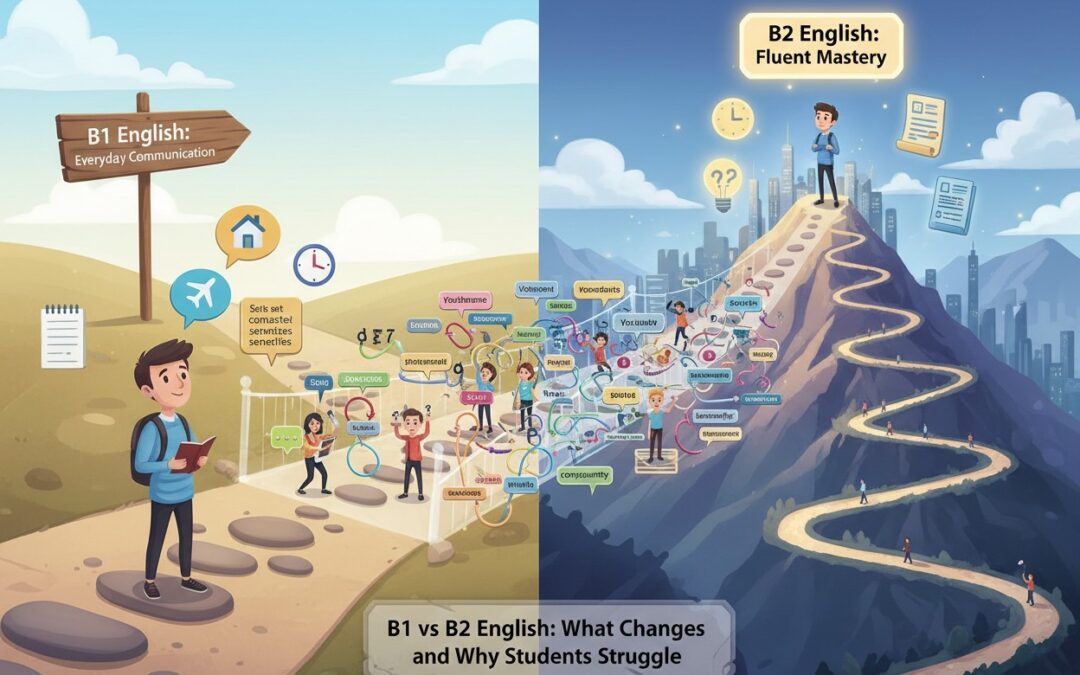
B1 vs B2 English: What Changes and Why Students Struggle
Understanding the differences between B1 and B2 English levels is crucial for learners aiming to advance their language skills effectively. This comparison not only highlights key changes but also explains common challenges students face during this transition.
Grammar Differences
At the B1 level, learners use basic grammatical structures confidently but may struggle with more complex forms. B2 learners are expected to handle a wider range of tenses and more intricate sentence structures, including conditionals, passive voice, and reported speech with greater accuracy.
Vocabulary Expectations
B1 vocabulary covers everyday topics and familiar scenarios, while B2 learners are expected to use a broader, more nuanced vocabulary, including idiomatic expressions and less common words. This expansion allows them to express ideas more precisely and handle abstract topics.
Writing Complexity
B1 writing typically involves straightforward, well-structured texts on familiar subjects. At B2, learners should produce more detailed and coherent writing, with clear argumentation and appropriate linking words, demonstrating a deeper understanding of style and tone.
Speaking Fluency Expectations
B1 speakers can communicate in routine tasks but may hesitate or search for words. B2 speakers are expected to speak more fluently and spontaneously, participate actively in discussions, and express opinions clearly, even on complex topics.
Real Example Answers
B1: “I like to travel because it’s fun and I can meet new people.”
B2: “I enjoy traveling because it broadens my perspective and allows me to experience different cultures firsthand.”
How to Transition Successfully
- Practice advanced grammar through targeted exercises
- Expand vocabulary by reading varied materials and noting new words
- Write regularly, focusing on structure and coherence
- Engage in conversations on diverse topics to build fluency
- Seek feedback from teachers or language partners to identify areas for improvement
By understanding these changes and focusing on specific skills, learners can overcome challenges and confidently progress from B1 to B2 English.
Frequently Asked Questions
B1 English focuses on everyday communication, while B2 requires stronger grammar, broader vocabulary, and the ability to discuss more complex topics confidently.
Many learners struggle because B2 exams demand better reading comprehension, improved writing structure, faster listening skills, and more fluent speaking abilities.
Yes. B2 is a noticeable step up from B1 and requires learners to understand detailed texts, express opinions clearly, and communicate naturally in different situations.
The timeline depends on study habits and practice frequency, but many learners need several months of focused preparation to move successfully from B1 to B2.
Reading, writing, listening, speaking, grammar accuracy, vocabulary development, and time management are all important for passing a B2 English exam.
Some learners prepare independently using practice tests and online resources, but structured lessons often help students improve faster and avoid common mistakes.